
01
Plate Tectonics
Watch divergent, convergent and transform boundaries build ridges, trenches and faults over time.
- Real example: the Mid-Atlantic Ridge
- Real example: the Japan Trench and the Japanese islands
- Real example: the San Andreas Fault
Plate tectonics, seismic waves, epicenter location, volcanic eruptions, lava flow, the rock cycle, Earth's interior, geomagnetism and atmospheric circulation. Nine simulations unfold in four phases and finish at a real landform or a representative observation.
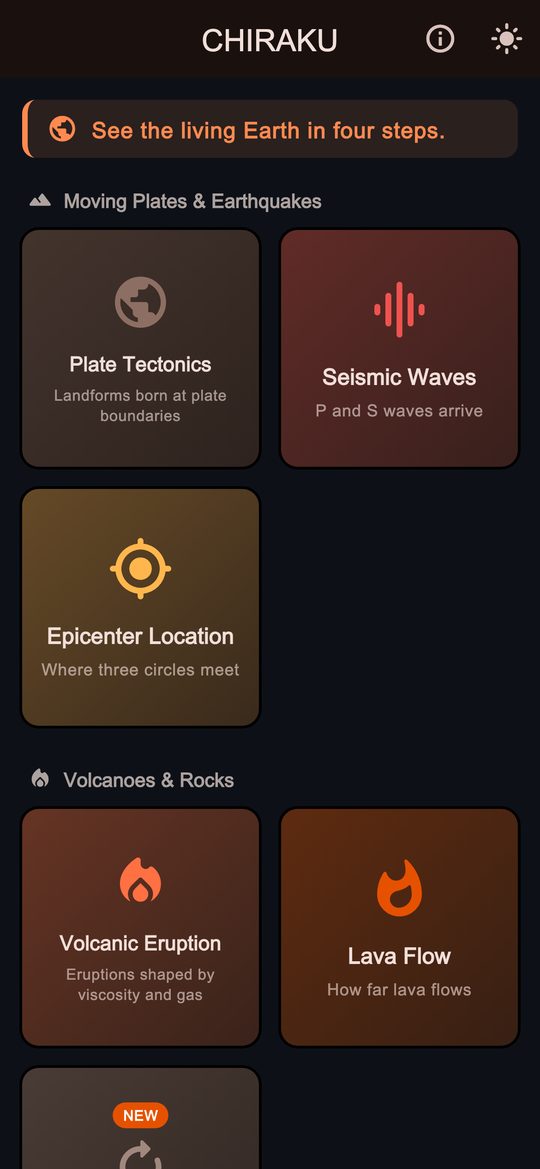
Moving plates and earthquakes, volcanoes and rocks, and the Earth inside and around it. Every simulation runs through four phases — start, forming, developing, complete — and ends at a real-world example.
Watch divergent, convergent and transform boundaries build ridges, trenches and faults over time.
P and S waves spread from the focus until three seismographs record the initial tremor and the main shaking.
Turn the S–P time into distance with Omori's formula, then find the epicenter where three circles meet.
Viscosity and gas content set the eruption style — from Hawaiian to Plinian in four stages.
Release four lavas of different viscosity and compare their speed, thickness and how far they travel.
Follow one rock as it turns igneous, sedimentary and metamorphic, and melts back into magma.
Crust, mantle, outer and inner core — and the S-wave shadow zone made by the liquid outer core.
The dipole field from the core's dynamo, the magnetosphere that deflects the solar wind, and field reversals.
Three cells driven by heating at the equator, and the belts of trade winds, westerlies and polar easterlies.
The current phase and a one-line explanation are always shown at the top, and every element — plates, mantle, focus, stations — is labeled.
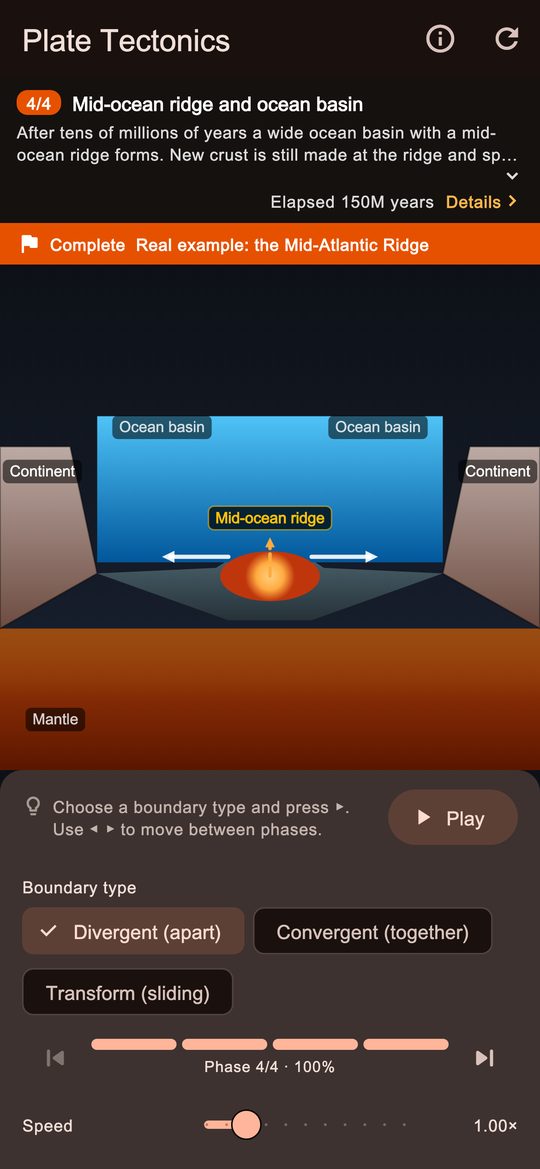
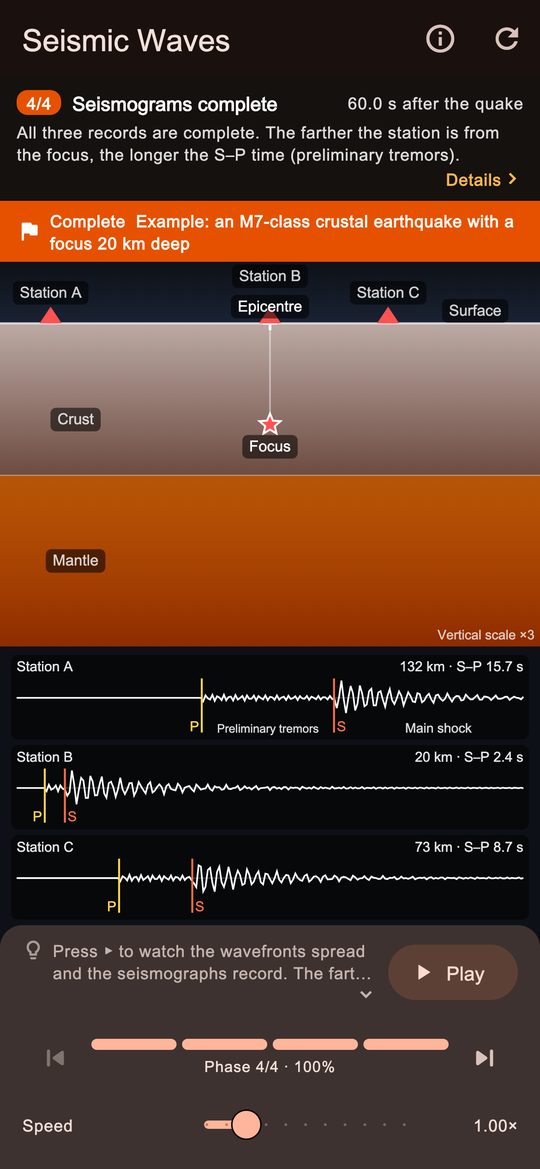
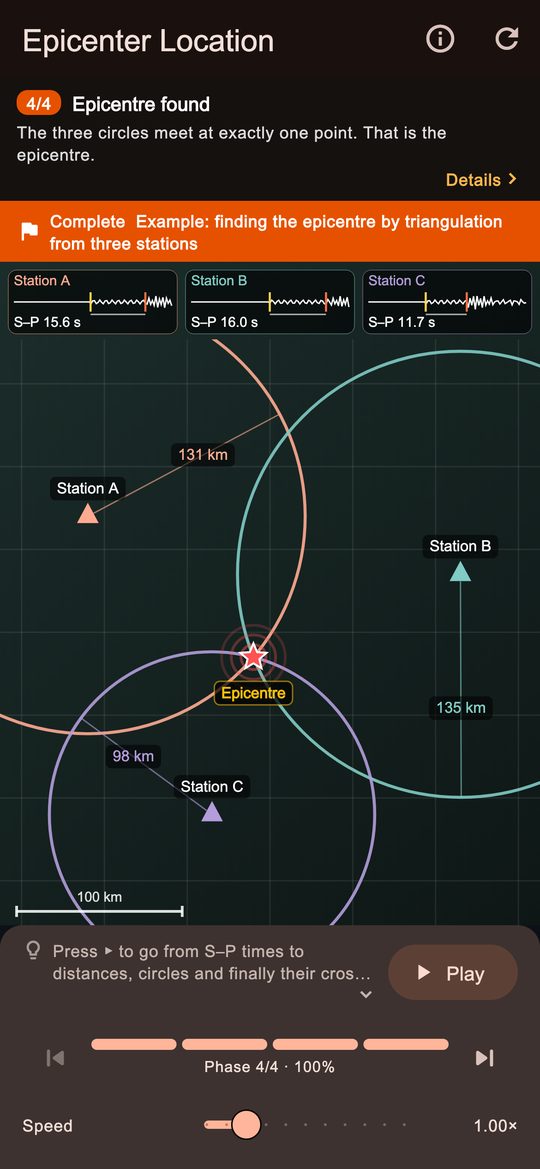
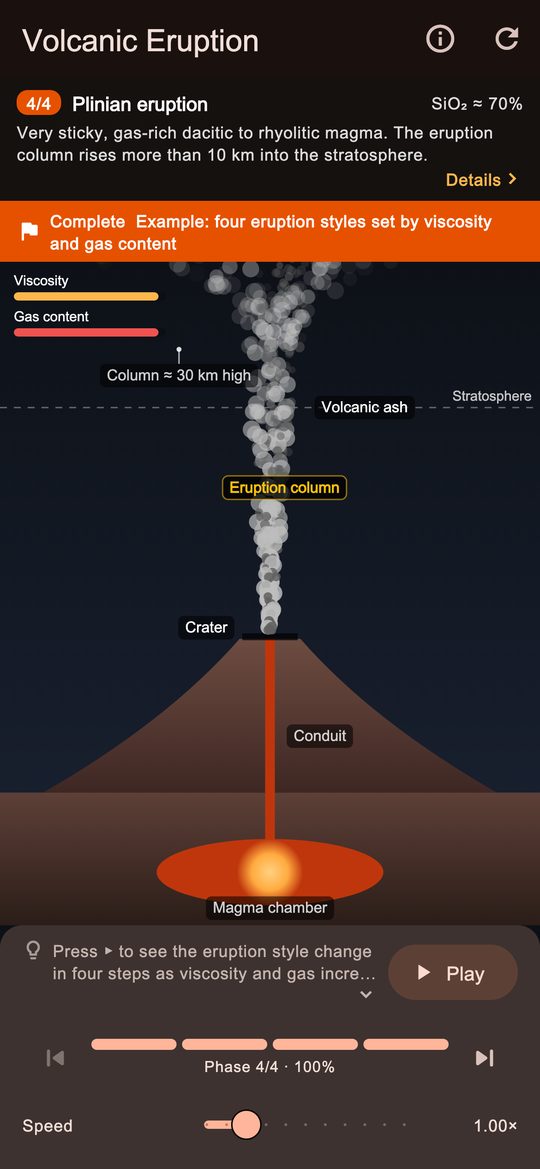
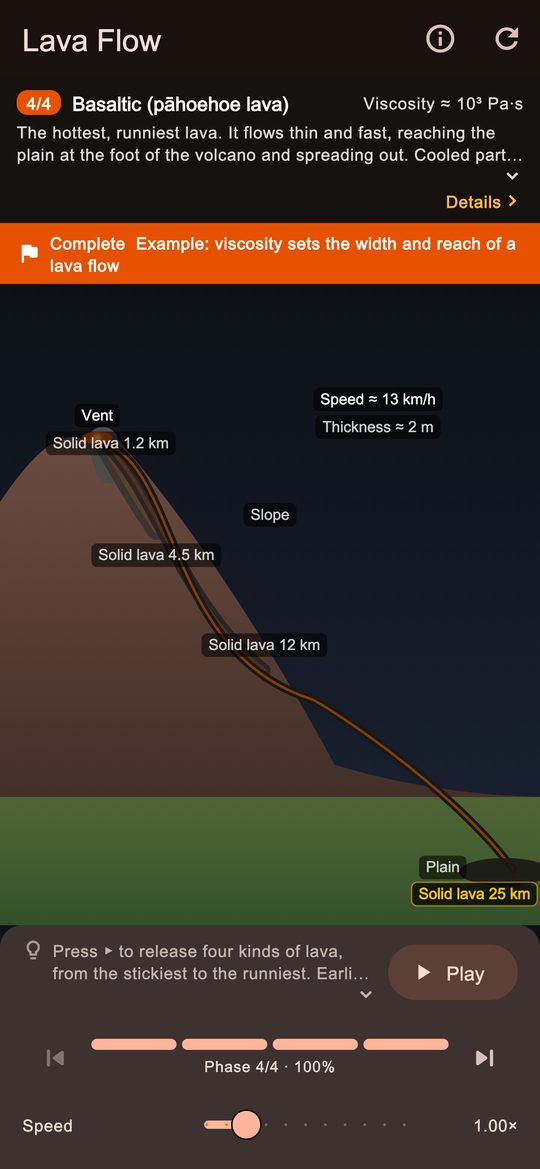
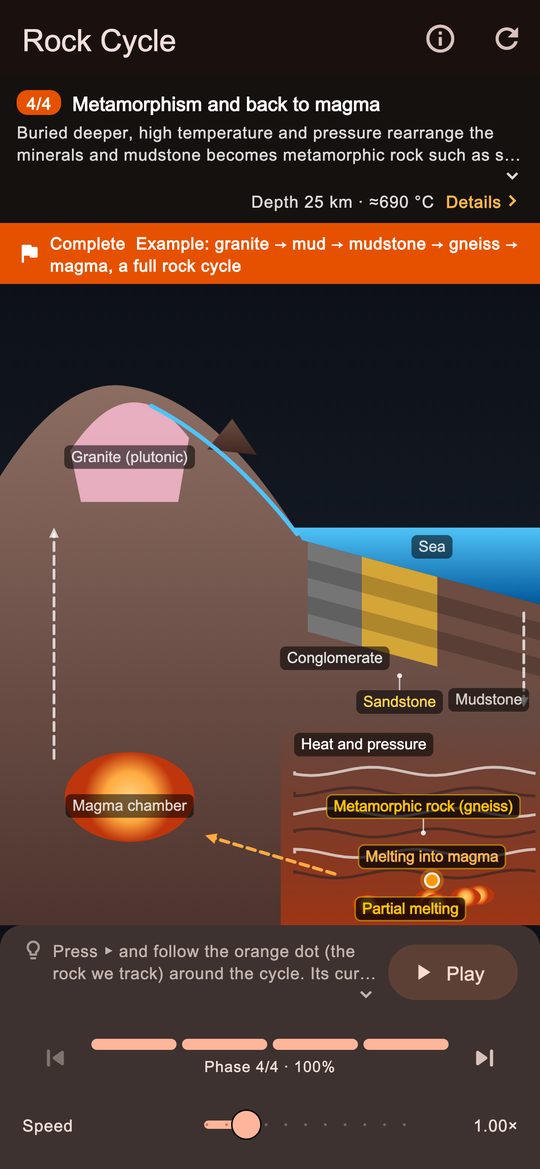
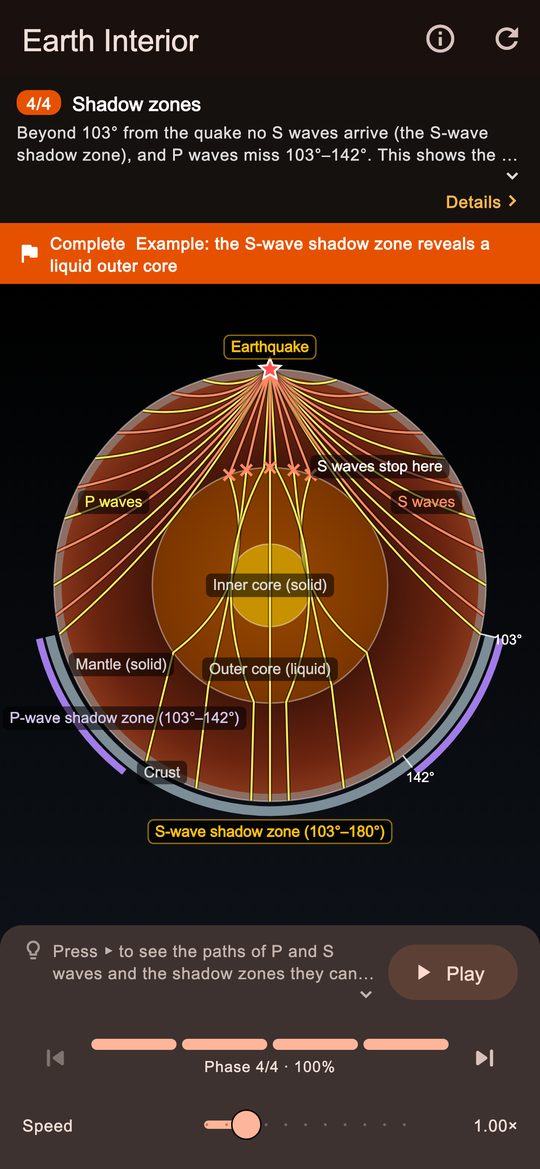
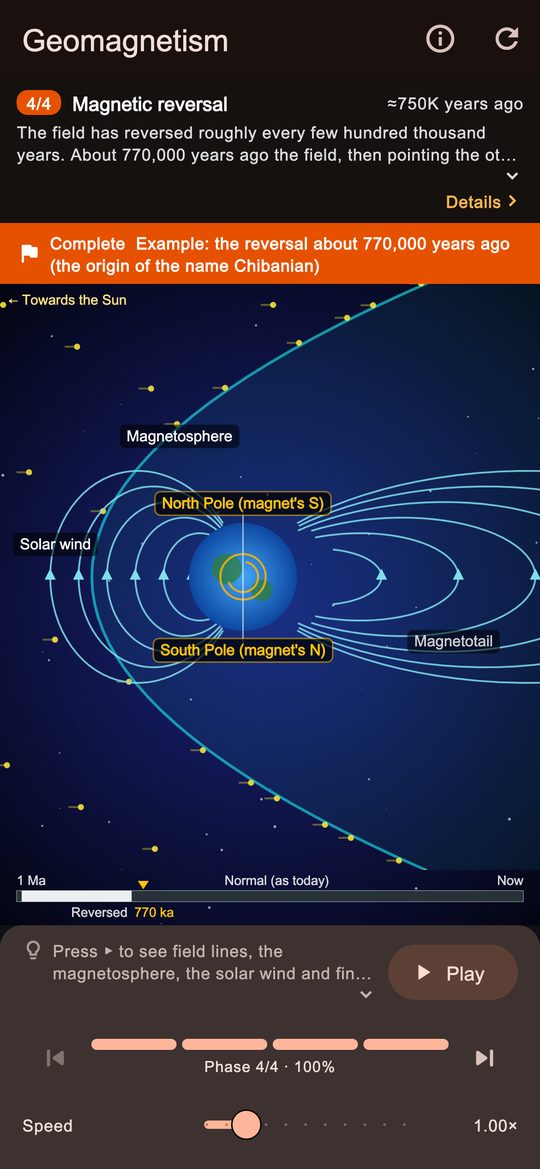
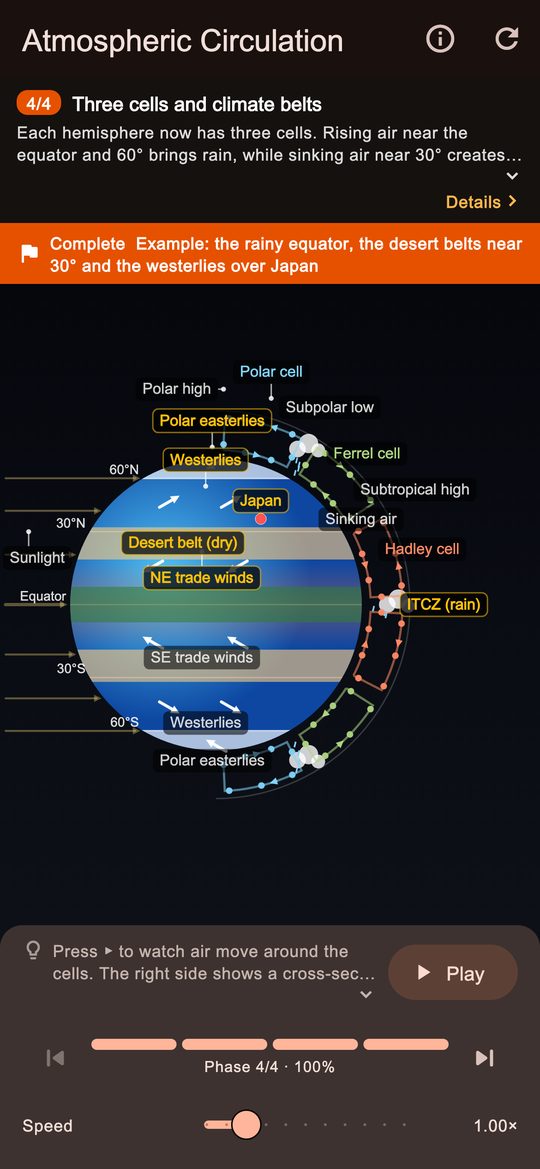
Every simulation works the same way.
Tap one of the nine cards on the home screen.
Tap the "Tap to start" button in the middle of the screen to begin. Some simulations let you choose options first, such as the boundary type.
The dark band at the top shows "Phase N/4" and a one-line explanation. Step between phases with ◀ ▶ and set the speed from 0.5x to 3x.
In the last phase the real-world example appears in an orange band and the simulation stops. Tap "Details" on the band for the terms and formulas.
Every simulation runs in four phases, so you always know what is happening and where it ends.
Plates, mantle, trench, fault, focus, magnetosphere — each element on screen carries a label.
Info sheets cover Omori's formula, Jeffreys' equation, Snell's law, the Coriolis force and more.
Set the speed from 0.5x to 3x, and step back and forth between phases with the ◀ ▶ buttons.
Dark and light themes, optimized for both phones and tablets.
English, Japanese, Chinese (Simplified/Traditional), Korean, Spanish, Portuguese, German, French, Hindi, Indonesian, Russian, Italian, Turkish, Thai and Vietnamese, following your device language.
The app is free. There are no in-app purchases, subscriptions or paid unlocks.
A Pangle banner ad is shown at the bottom of the screen. On iOS, the App Tracking Transparency (ATT) prompt appears at launch, and ads are personalized only if you allow tracking. On Android, the app asks once whether ads may be personalized. Either choice can be changed later from "About this app" > "Ad settings". The app itself has no accounts and never asks for or collects personal information such as your name or email address; it stores only your theme and ad choice on the device.
Requirements: iPhone and iPad with iOS 15.0 or later; Android 7.0 (API 24) or later phones and tablets.